
Navigation Menu

No sign-up or measuring tools are needed. Snap or upload a photo and Face Shape Snap quickly analyzes your face shape and helps you explore styles that suit you.
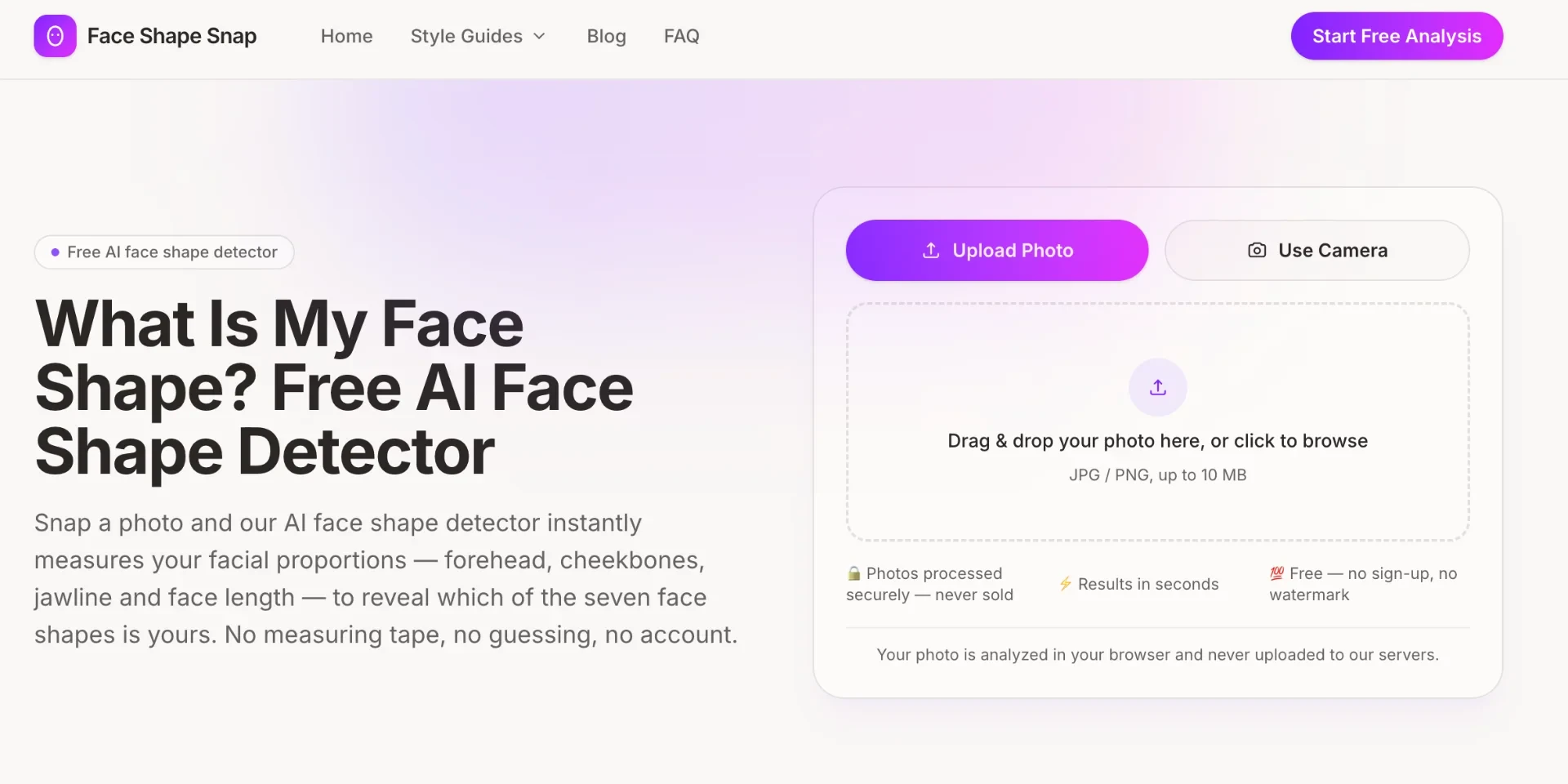
Face Shape Snap is a free online AI face shape detector designed to help people understand their facial proportions through a simple selfie or front-facing photo. The question “What is my face shape?” sounds easy, but it is often surprisingly difficult to answer accurately by simply looking in a mirror. Hair, lighting, camera angle, expression, glasses, and personal perception can all influence how a face appears. Face Shape Snap approaches the problem differently by analyzing visible facial geometry and comparing the proportions of the forehead, cheekbones, jawline, and overall face length. The result is a practical face-shape classification that can then be connected to useful styling ideas. The platform currently recognizes seven common face shapes: oval, round, square, heart, diamond, oblong, and triangle. Each category describes a different combination of facial proportions. An oval face generally has cheekbones as a wider point and a softly rounded chin. A round face tends to have a similar width and length with softer contours. A square face typically has more angular structure and relatively similar widths across the forehead, cheekbones, and jaw. A heart-shaped face is generally wider around the forehead and tapers toward the chin. A diamond shape tends to be widest around the cheekbones, while an oblong face is noticeably longer than it is wide. A triangle shape is characterized by a relatively wider jaw compared with the forehead. The purpose of these categories is not to place people into rigid beauty standards. Instead, Face Shape Snap uses them as a practical framework for understanding facial proportions. Knowing your face shape can provide a useful starting point when making everyday style decisions. Hairstyles, glasses, and makeup can all change the visual balance of a face, and different proportions can make certain shapes, lines, or placements appear differently. By identifying a face shape first, users can explore styling options with more context instead of browsing completely generic recommendations. The experience begins with a photograph. Users can upload a JPG or PNG image or use the camera on their device. The website does not require an account, email address, or watermark, making the process intentionally lightweight. A clear front-facing photo is recommended because the detector needs to compare visible horizontal and vertical proportions. A photo taken at a strong angle, with uneven lighting, or with significant portions of the forehead or jaw hidden can make the visible geometry harder to interpret. For that reason, using a straightforward portrait with the face clearly visible is the best starting point. Once the photo is provided, Face Shape Snap analyzes facial landmarks in the browser. The site explains that the detector identifies dozens of facial landmarks, including points around the forehead, cheekbones, jaw, and chin. It then compares measurements and ratios such as forehead width, cheekbone width, jaw width, and face length relative to width. These relationships provide the basis for determining which of the seven face-shape categories most closely matches the visible proportions in the submitted image. This approach is different from simply asking a user to compare their selfie with a set of example pictures. The browser-based approach is also an important part of the product experience. Face Shape Snap states that the photo is analyzed directly in the user's browser and is never uploaded to its servers. This means the analysis takes place on the user's own device rather than requiring the photo to be sent to a remote processing system. The website also emphasizes that photos are processed securely and are not sold. For users who want to experiment with face shape analysis without creating an account or submitting their personal photo to a server, this privacy-oriented workflow can make the experience more comfortable. The process is designed to be fast as well. The site describes the analysis as taking approximately a second, so users do not need to wait through a long upload or processing workflow. Once the result is ready, the platform can direct users toward style guides related to their identified face shape. This creates a simple progression: provide a photo, analyze facial proportions, discover the face shape, and then explore practical styling ideas. One of the strongest aspects of Face Shape Snap is that the result is not intended to be the end of the experience. A basic face detector might simply tell someone “you have an oval face” and leave them with another question: what should they do with that information? Face Shape Snap addresses that gap through built-in style guides covering hairstyles, glasses, and makeup. The face shape becomes a starting point for further exploration rather than an isolated label. For hairstyle decisions, face shape can be useful as one of several considerations. Different hair lengths, layers, volumes, and silhouettes can change the apparent balance between facial width and length. A person who knows whether their face is relatively round, long, angular, or tapered can use that information when researching potential hairstyles. Face Shape Snap's style guides make this process easier by connecting face shape categories with hairstyle ideas. The goal is not to dictate one “correct” haircut, but to give users a more focused collection of possibilities to explore. Glasses are another natural use case. Eyewear sits directly on the face and can strongly influence its visual structure. A frame can add angles, create width, soften a strong jaw, or emphasize particular proportions. Rather than choosing frames without any reference to facial structure, users can first determine their face shape and then explore glasses guidance related to that category. Face Shape Snap therefore provides a useful first filter for people shopping for sunglasses, prescription frames, or everyday eyewear. Makeup provides another area where face shape can serve as a useful reference. Contouring, blush placement, eyebrow styling, and other makeup choices can affect how the proportions of the face are perceived. Face Shape Snap includes makeup ideas within its style-guide structure, allowing users to continue from their face-shape result into a broader styling exploration. This makes the platform relevant not only to people looking for a haircut, but also to makeup enthusiasts and anyone experimenting with their personal appearance. The seven-category system also helps users learn the differences between facial shapes. For example, oval and oblong faces can both appear longer than they are wide, but the overall outline differs. The site explains that an oval face generally has cheekbones as its widest point and a softly rounded chin, while an oblong face is more noticeably elongated with straighter sides. Understanding these distinctions can make the analysis more educational because users can see why a particular category may have been selected instead of simply receiving an unexplained label. The same principle applies to round and square faces. Both can have relatively similar width and length, but the outline and jaw structure are different. Round faces tend to have softer curves and fewer obvious angles, while square faces typically have stronger, more angular jaw structure. By focusing on proportions and geometry, Face Shape Snap provides a framework that helps users understand these visual differences. Heart, diamond, and triangle shapes demonstrate another important aspect of face-shape analysis: where the widest part of the face appears. A heart-shaped face generally begins wider around the forehead and narrows toward the chin. A diamond shape is commonly widest around the cheekbones with a narrower forehead and jaw. A triangle shape has a comparatively wider jaw and a narrower upper face. These distinctions can become useful when users move from analysis into hairstyle, glasses, or makeup exploration because each category creates a different overall silhouette. Privacy is a particularly important consideration for any service that works with personal photographs. Face Shape Snap addresses this directly by keeping the analysis inside the browser. The site states that the image never leaves the user's device, while also presenting the detector as free to use without an account. Users therefore do not need to create a persistent profile simply to answer a basic question about their face shape. The absence of sign-up requirements also makes the tool more convenient for quick, one-time use. The platform is also designed to work across modern devices. Users can access it through a phone, tablet, or desktop browser and either upload an existing photo or use a camera. This makes it suitable for different everyday situations. Someone shopping for glasses on a phone can quickly run an analysis. Someone preparing for a haircut can test a recent portrait. A makeup enthusiast can use a selfie to explore face-shape-related guidance. Because there is no software installation requirement, the barrier to trying the tool remains low. Another useful aspect is the fact that Face Shape Snap is completely free according to its homepage. There is no account requirement, no email requirement, and no watermark on the analysis experience. This makes it accessible to users who simply want to test the concept before committing to a more complicated beauty or styling service. It also makes the platform suitable for repeated experimentation, such as testing different clear photos to see how lighting, angle, or framing may affect the visible proportions. Face Shape Snap can also be useful in professional styling contexts. The site's FAQ notes that hairstylists and makeup artists can use the face shape detector with clients, provided they have the right to use the submitted photo. In this context, the tool can serve as a quick visual reference before discussing hairstyle or makeup options. It does not replace the judgment of a professional stylist, but it can provide an additional starting point for conversations about proportions and overall face structure. It is also important to understand what Face Shape Snap is and what it is not. The tool analyzes facial proportions and categorizes visible structure. It is not an attractiveness rating system, identity verification system, or medical diagnostic tool. The result should be treated as a practical styling reference rather than an absolute statement about a person's appearance. Real faces can sit between categories, and the visible result can change depending on lighting, pose, expression, hairstyle, glasses, and camera angle. This is a normal limitation of photo-based face-shape analysis and one reason a clear, front-facing image is recommended. This positioning makes Face Shape Snap different from services that focus primarily on beauty scores. Instead of asking users to compare themselves against a numerical attractiveness standard, it focuses on a neutral structural question: how are the visible proportions of the face organized? That information can then be used for practical choices. Users can decide whether a particular hairstyle feels right, compare different glasses, explore makeup techniques, or simply learn more about their own facial structure. The overall workflow can therefore be understood as three connected stages. First comes discovery: use a photo to identify the face shape. Second comes understanding: learn what the detected category means in terms of forehead, cheekbone, jaw, and face-length proportions. Third comes application: explore hairstyles, glasses, and makeup ideas associated with the result. This structure turns a simple AI classification tool into a more useful personal styling resource. For people who have never thought about face shape before, this can be an approachable introduction to facial proportions. Instead of requiring technical knowledge, Face Shape Snap translates the analysis into familiar categories. The seven shape guides also give users a way to continue learning after the scan. If someone receives a result they do not recognize, they can compare it with the descriptions of the different categories and better understand which features distinguish them. The platform can also help reduce the amount of guesswork involved in style research. Rather than starting with hundreds of generic hairstyle pictures, users can begin with their face-shape category and then explore relevant recommendations. Rather than trying random glasses frames, they can first understand whether their face is relatively round, square, long, tapered, or angular. Rather than searching through completely general makeup tutorials, they can explore guidance connected to their facial structure. Ultimately, Face Shape Snap combines AI-based facial proportion analysis with practical style discovery in a lightweight browser experience. Its main functions include photo or camera input, facial landmark analysis, seven-category face-shape detection, proportion-based classification, browser-side processing, and style guides for hairstyles, glasses, and makeup. The service is free, requires no account, and is designed to provide results quickly. The most useful way to think about Face Shape Snap is not as a system that tells people what they should look like, but as a tool that helps people understand their visible facial structure and use that information when exploring personal style. Whether someone is curious about their face shape, preparing for a haircut, shopping for eyewear, experimenting with makeup, or helping a client explore styling options, the platform offers a simple place to begin. By turning a selfie into an easy-to-understand face-shape result and then connecting that result with practical style guides, Face Shape Snap closes the gap between analysis and action. Instead of stopping at “this is your face shape,” it encourages users to ask the more useful follow-up question: “Now that I know my proportions, what styles can I explore?” That combination of quick analysis, privacy-focused browser processing, seven face-shape categories, and practical styling inspiration makes Face Shape Snap a convenient tool for anyone interested in understanding and experimenting with their personal appearance.